Author Topic: How do I know if DNA ThruLines for a potential ancestor are true?  (Read 251 times)

Offline Biggles50

  • RootsChat Aristocrat
  • ******
  • Posts: 2,012
A cluster is a variation of “The Leeds Method”, so do look this up and read her instructions on using it and also the limitations.

A cluster in ProTools charts DNA matches that share 20cM+

The Ancestry guide on Clusters is here

https://support.ancestry.co.uk/s/article/Matches-by-Cluster

Basically in the By Cluster tab, select a person who is a DNA match and follow the instructions.

The chart has matches showing on both axis and the dark squares are ignored as they show the vertical axis match against their position on the horizontal axis.

The coloured squares show each match against all the others, i.e. select one on the vertical axis and move horizontally one square at a time, where they are coloured they match the person on the horizontal axis.  No coloured square indicates that the either share less than 20cM with the person on the horizontal axis or no cM or less than reported.

We look at each match on the vertical axis and use all those who share above 20cM with them, coloured squares, to help incorporate them into our tree.  Often one of these will unlock the mystery.

The article I gave the link to has strategies listed, but we each develop our own.

The usual issues with matches do complicate matters, that is:- user names that do not ID them, no tree, no DNA shared with people we already have in our tree etc.

Offline Albufera32

  • RootsChat Senior
  • ****
  • Posts: 276
  • Census information Crown Copyright, from www.nationalarchives.gov.uk
I am interested in this thread mainly because I am a complete beginner when it comes to cluster groups, so I  am hoping I will learn something useful following this. Even based on my minimal understanding, it appears virtually every square of the first group is coloured in, and at least 9 of the people are matches with everyone else in the group, so I would say there is pretty clear evidence of a connection (that is, assuming my understanding is even vaguely correct).

What I would suggest however, is that you replace the images shown with ones with the side panel on the left removed, since that is a list of names of people who are presumably likely to be still living. Maybe I am being too sensitive though, since no one seems to have queried the earlier post including a similar image.
Howie (Riccarton Ayrshire)
McNeil/ McNeill (Argyll)
Main (Airdrie Lanarkshire)
Grant (Lanarkshire and Bo'ness)
More (Lanarkshire)
Ure (Polmont)
Colligan (Lanarkshire)
Drinnan (New Zealand)

Offline 4b2

  • RootsChat Senior
  • ****
  • Posts: 344
The end result is for me I am not really interested in DNA matches who share DNA with me if said share is 15cM or less, the caveat being unless there is a compelling reason to research them further.

What is a compelling reason? I can clearly see there is a degrading quality of matches from 15 down to 8cM. This can be ascertained by the frequency at which descending cM matches don't correlate into any discernable cluster. I will treat a lower cM match (8-14) the same as a higher on if I am researching a cluster when it clearly has an overlap with the cluster, i.e. it is a shared match of 5, 10, 20+ matches in that cluster.

I don't really know what the frequency of them being a false positive is. There, of course, can be a small error in Ancestry's reading of the DNA that could throw such matches into your cluster erroneously. I pay attention to if you sometimes get two siblings or close relatives as low-cM matches, because that virtually rules out errors in reading. But I've not seen any scientific literature that states what the odds of these matches being more in the IBS category is.

When looking through likely MyHeritage IBS matches, I note that they just don't seem to have any correlation. They are just random matches based on mostly incidental segments. So that also makes me think clustered lower-cM Ancestry matches are more worthwhile.

Offline 4b2

  • RootsChat Senior
  • ****
  • Posts: 344
I've got some work to do! I do know that when I looked at ThruLines, I added all those descendant matches to a "Steinbrecher" group I created. Then looked at each of them individually and see if they matched each other. I went through the first 3 matches and they match 10,12 14 people in that Steinbrecher group that I had created and added those descendants to. So that's a positive sign perhaps?

The level of work varies depending on the quantity and quality of your matches. If you have a very thick cluster of matches, say with 1st, 2nd, 3rd, 4th, 5th, 6th cousins within it, by going through all the obvious clustered matches you should be able to find a lot of matches with common or potentially common ancestry (less time). Other times the clusters of matches can be a bit more fragmentary. You can have 2-3 clusters of DNA matches that don't overlap, despite sharing the same ancestors. For other lines of ancestry there may be very few discernable descendants with DNA tests - if any.

It's hard to tell based on comments on a forum regrading this: the first 3 matches and they match 10,12 14 people in that Steinbrecher group, but it sounds like this is a cluster.

If you put them all in a graph showing which are shared matches and it looks something like this:
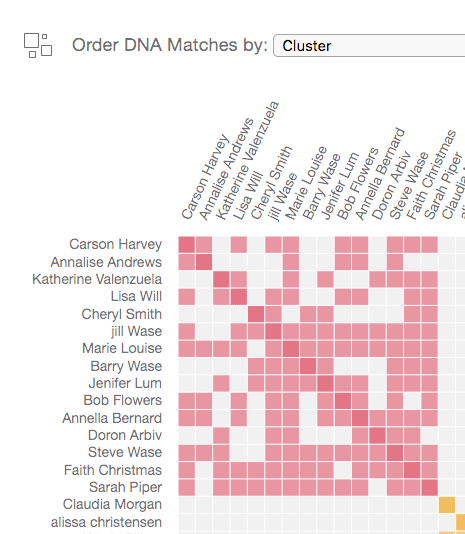


Then that is a cluster, and you'd expect to find common ancestors among the matches. You can have shared matches on the same line that happen to cluster with none of the other matches, or as mentioned, more than one cluster for the same line of ancestry. There's a range of things you can expect.

You can appraise matches, even with basic trees quite quickly, by opening up the dead-ends in the tree, then press 'Search' at the top and you will typically find other trees with a continuation of the line:


Those trees can, of course, have errors, but this saves you having to research 100s and 1,000s of other people's trees.

ProTools is very useful for figuring out some unknown clusters, as it better pinpoints the relevant lines of ancestry. It also helps save time by letting you single out the most obviously related matches.